

Finding yoga classes in Nashik is easy. Finding the right one is harder. Some classes are crowded and rushed. Some assume you can already touch your toes. Others run at hours that make no sense if you are juggling college, a job, school pickups or a house full of relatives.
This guide to yoga classes in Nashik is for women and girls who want to start yoga, return to it after a long break, or move to a class that suits them better. It covers the styles worth knowing, what a good class looks like, how to judge a studio on your first visit, and how to choose between options across the city, including yoga classes in Pathardi Phata and the areas around it.
I have not ranked individual studios, because a ranking only helps if you can check it yourself. Instead, you get a checklist you can carry to any of the yoga classes in Nashik you visit, and a clearer idea of what “best” means for your body, your schedule and your goals.
Why many women prefer women-only yoga batches
Yoga is not a competitive activity, but a mixed room can still feel awkward. Plenty of women say they relax more when they are not worried about how they look in a forward fold or whether a stranger is watching during a stretch. Women-only batches at yoga classes in Nashik remove that distraction, and for many beginners it is the reason they actually turn up.
There are practical reasons too. Instructors in women-only groups often plan for things that come up in women’s lives: tight hips from long hours at a desk, back pain after pregnancy, tired shoulders from carrying bags or children, and the changes that come with periods and menopause. A teacher who expects these questions tends to answer them without fuss.
Girls in school and college benefit in a similar way. A younger student may be shy about asking basic questions. A calm, same-gender group makes it easier to say “I don’t understand this pose” out loud, which is how people learn.
That said, a women-only label does not guarantee that yoga classes in Nashik are well taught. A poorly taught class is still poorly taught. Use it as one factor among several, not as the only test.
Yoga styles worth knowing before you enroll
Most yoga classes in Nashik teach a mix of styles, and the names are used loosely. Knowing the basics helps you read a class description and pick something that matches your energy.
Hatha yoga. Slow, steady and focused on holding poses with attention to breathing. This is the usual starting point for beginners, and a good choice if you have not exercised in years.
Vinyasa or flow yoga. Poses are linked together with the breath, so the class keeps moving. It raises your heart rate more than Hatha does, and suits people who get bored holding a pose.
Power yoga. A faster, more athletic class that builds strength and stamina. Try it once you are comfortable with the basic poses, not on day one.
Iyengar yoga. Precise and alignment-focused, often using props such as blocks, belts and bolsters. It works well for people with stiffness, minor injuries or a habit of rushing through poses.
Restorative yoga. Very slow, with long supported holds. If you sleep badly or feel permanently wound up, a weekly restorative class can be a welcome change of pace.
Prenatal and postnatal yoga. Taught by instructors trained to adapt poses for pregnancy and recovery. Ask about their training before you join, and speak to your doctor first.
Pranayama and meditation. Breathing practices and guided stillness. Many classes include ten minutes of this at the end, and some offer it as a separate session.
If you are unsure which of the yoga classes in Nashik to try, begin with Hatha or a beginner-level mixed class for a month. You can always move to something more demanding later.
What a good yoga class looks like
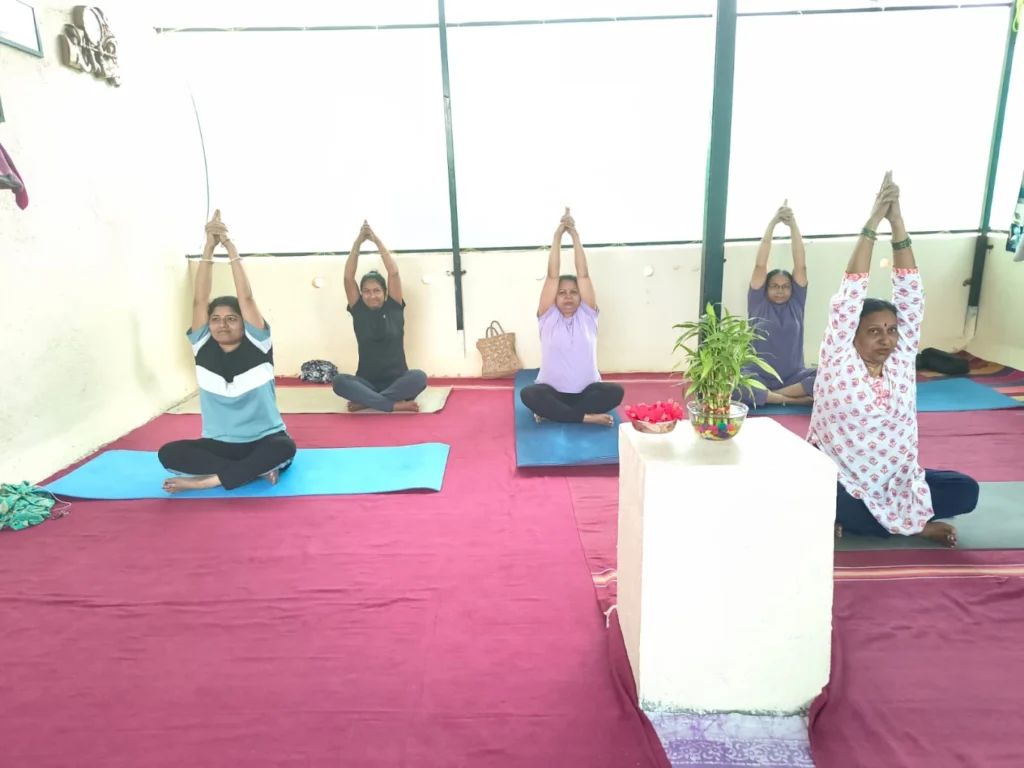
You can learn a lot about yoga classes in Nashik in the first fifteen minutes of a trial. Here is what to watch for.
The teacher explains before they demonstrate. A good instructor tells you where to place your feet, when to breathe in and how deep to go. They also offer easier versions of each pose, so no one in the room feels left behind.
The batch size is manageable. There is no fixed number, but you should be able to see the teacher and be seen. If the room is so full that mats touch, you will not get any correction.
Beginners are not ignored. Look at how the teacher treats a newcomer. Do they walk over, check your posture and suggest a modification? Or do they carry on with the advanced students while you struggle?
The class has a shape. A sensible session usually moves from warm-up to main poses, then to cooling down and a few minutes of relaxation. Classes that skip the warm-up or the final rest are worth being cautious about.
Pain is treated as a signal. A teacher who says “push through it” is a red flag. Stretching can feel intense, but sharp or pinching pain means you should back off. Good instructors say so out loud.
The space is clean and calm. You do not need an expensive studio. You do need a floor you can lie on comfortably, decent ventilation, a changing area and enough privacy that you feel at ease.
Teacher qualifications matter, but they are not the whole story. A certificate tells you someone completed a course. It does not tell you whether they can teach a nervous beginner. Ask about training, and then judge for yourself by attending a trial class.
Yoga classes in Pathardi Phata
Pathardi Phata is a busy residential and commercial pocket of Nashik, and many families there prefer to keep daily activities close to home. If that is you, yoga classes in Pathardi Phata have one clear advantage: you are far more likely to show up if the class is ten minutes away than if it takes forty.
When you compare options in the area, a few local questions are worth asking:
- How long is the commute at your class time? A studio that looks close on a map can be slow to reach during morning or evening traffic. Test the route at the hour you would actually travel.
- Is there a women-only or women-and-girls batch? Not every studio has one at every time slot, so ask which batches are open and which are full.
- Is parking or safe walking access available? This matters more for early-morning and late-evening batches.
- Can you attend a trial class? A single session tells you more than any description or photo.
If you cannot find a good fit within walking distance, widen the search to other yoga classes in Nashik rather than settling for a class you dislike. A slightly longer trip to a teacher you trust usually beats a convenient class you stop attending after two weeks.
Choosing by life stage
Among yoga classes in Nashik, the best one for a college student is not the best class for a woman in her fifties. Here is a rough guide.
School and college girls. Look for beginner-friendly Hatha or gentle flow classes with a teacher who explains each pose properly. Exam stress, long hours of sitting and poor posture from phones and laptops are common issues, so classes that include breathing practice and shoulder and neck work are useful. Check the timing against your timetable, and if you are under 18, make sure a parent knows the studio and the teacher.
Working women. Your main limit is time. Early-morning and evening batches suit most people, and a 45 to 60 minute session is easier to keep up than a long weekend workshop. Look for classes that address tight hips, lower-back strain and neck stiffness from desk work.
Homemakers. You may have the flexibility to choose a mid-morning or afternoon batch, which tend to be calmer and less crowded. A regular class can also give you something that belongs to you, apart from the household routine, which many women find just as valuable as the exercise.
During pregnancy and after childbirth. Do not join a general class and hope for the best. Talk to your doctor first, then look for an instructor who has specific training in prenatal or postnatal yoga and who asks about your stage of pregnancy or recovery before you begin.
Women in their forties and beyond. Stiffness in the knees, shoulders and spine is common, and many women are also dealing with changes around menopause. Slower classes with props, such as Iyengar-style or restorative sessions, can feel kinder than a fast flow. Mention any health conditions to the teacher before the first class.
If you have a medical condition, an injury or a recent surgery, get your doctor’s advice before you start. A good instructor will also ask about this and adjust poses for you.
Questions to ask before you pay
When you shortlist yoga classes in Nashik, ask for a trial class or a short conversation before you commit. These questions get useful answers quickly:
- What level is this batch, and is it suitable for a complete beginner?
- How many people are in the class, and who is the teacher?
- What training or experience does the instructor have, and have they taught women with my needs (pregnancy, back pain, age)?
- What happens if I miss a class? Are there make-up sessions?
- What is the fee structure, and is there any joining or registration fee on top?
- Do I need to bring my own mat, or are mats provided?
- Can I switch batches if my schedule changes?
Pay attention to how the answers are given. A studio that answers plainly and does not pressure you into a long prepaid plan is usually easier to deal with later.
Offline, online or both
In-person yoga classes in Nashik give you hands-on correction and a fixed routine. Online classes give you flexibility, and they can work well if you already know the basic poses or live far from a good teacher.
For a true beginner, I would start in person for at least the first few weeks. A teacher in the room can see that your knee is collapsing inward or your lower back is overarching, and a screen often cannot. Once you are confident, adding an online session on busy days is a practical way to keep the habit going.
If you do go online, make sure the teacher can see you on camera and gives feedback, rather than simply playing a recording.
How to start and stay consistent
Most people do not quit yoga because it is too hard. They quit because it stops fitting into their week. A few habits help.
Start small. Two or three classes a week are enough at the beginning. Adding more later is easier than recovering from burnout.
Pick a fixed time. A class at the same hour each day or on the same days each week becomes routine faster than one you have to decide on afresh every morning.
Wear what you can move in. Comfortable, stretchy clothing that stays put when you bend is more important than any particular brand. If you feel self-conscious about your outfit, you will think about it all through the class.
Eat lightly before class. Most teachers suggest leaving a gap of a couple of hours after a full meal. If you feel faint without anything, have something small and easy to digest.
Do not compare yourself. The woman next to you may have practised for ten years. Your only useful comparison is with how you felt last week.
Be patient with your body. Flexibility and strength build slowly. Many people notice a difference in how they sleep, stand or breathe before they notice any change in how far they can bend.
Frequently asked questions
Is yoga suitable for complete beginners? Yes. Choose a beginner-level Hatha class and tell the teacher it is your first time. You do not need to be flexible to start.
How many days a week should I practise? Three days a week is a sensible target for most beginners. Even two regular sessions are better than a burst of daily classes followed by a long gap.
Can girls under 18 join adult batches? That depends on the studio. Ask whether there is a batch for teenagers or whether younger students are placed with adults, and make sure a parent is comfortable with the arrangement.
Is it safe to do yoga during periods? Many women continue with gentle practice during their periods, and some prefer to skip inverted poses or intense sessions. Follow how your body feels, and ask your teacher for suggestions.
How do I choose between yoga classes in Pathardi Phata and other parts of Nashik? Start with the commute at your class time, then compare the teacher, batch size and trial class experience. A class slightly further away can be the better choice if the teaching is clearly stronger.
Do I need a doctor’s approval first? If you have a health condition, are pregnant, or are recovering from an injury or surgery, yes. For healthy adults, a conversation with the teacher about any past problems is the minimum.
Final thoughts
The best yoga classes in Nashik for women and girls are not the ones with the longest list of promises. They are the ones where the teacher explains clearly, the batch size lets you be seen, the timing fits your life, and you leave feeling better than when you arrived.
Set aside a week, visit two or three places, and take a trial class at each. Whether you choose a studio close to home or yoga classes in Pathardi Phata that fit your route, trust your own experience of the room. After that, the only thing left is to roll out the mat and begin.
