

Most plants don’t think much about dosing pumps until one fails at the worst possible moment. A water treatment line drifts out of spec because a diaphragm cracked. A chemical feed system overdoses because someone picked a pump sized for a completely different flow range. These aren’t rare stories. They’re the normal result of buying a pump based on price or habit instead of the actual job it needs to do.
Dosing pumps (also called metering pumps or chemical injection pumps) are built to deliver precise, controlled volumes of liquid into a process. That precision is the entire point. A pump that’s off by even a few percent can throw a water treatment process out of balance, waste expensive chemicals, or damage downstream equipment. Getting the selection right upfront saves money and headaches for years afterward.
This guide walks through the practical factors that actually matter when picking a dosing pump for industrial use: chemical compatibility, flow rate, pressure, accuracy, and the operating environment. By the end, you should have a clear sense of what to look for and what to avoid.
What Is a Dosing Pump and Why Accuracy Matters
A dosing pump injects a specific, adjustable amount of fluid into a system over a set period of time. Unlike a general-purpose pump that just moves liquid from point A to point B, a dosing pump is designed for repeatability. Set it to deliver 2 liters per hour, and it should deliver 2 liters per hour, hour after hour, day after day.
That repeatability matters because dosing pumps are usually feeding something sensitive: chlorine into drinking water, coagulants into a wastewater line, additives into a food production process, or corrosion inhibitors into a boiler system. Too little, and the treatment doesn’t work. Too much, and you’ve either wasted chemical or created a new problem, sometimes a dangerous one.
Industries that rely heavily on dosing pumps include:
- Water and wastewater treatment
- Oil and gas processing
- Chemical manufacturing
- Food and beverage production
- Pulp and paper
- Power generation (boiler and cooling water treatment)
- Agriculture and irrigation
- Pharmaceutical and cosmetics manufacturing
Each of these has different fluids, pressures, and tolerances, which is exactly why there’s no single “best” dosing pump. The right choice depends on the specifics of your application.
Step 1: Identify the Chemical You’re Dosing
Before anything else, look at the fluid itself. Chemical compatibility determines which pump materials will survive contact with your dosing fluid, and this is where a lot of selection mistakes happen.
Consider:
- Corrosiveness. Acids, caustics, and oxidizers like sodium hypochlorite will eat through the wrong wetted materials fast. PVC, PVDF, and PTFE are common choices for aggressive chemicals, while stainless steel handles many but not all corrosive fluids.
- Viscosity. Thin fluids like water behave very differently from thick polymers or slurries. A pump designed for low-viscosity liquids may struggle to draw or push a thick fluid consistently.
- Abrasiveness. Fluids carrying suspended solids can wear down pump components, particularly seals and check valves, faster than clean liquids.
- Off-gassing or vapor pressure. Some chemicals release gas or vapor that can cause vapor lock in certain pump types, reducing accuracy.
Check the manufacturer’s chemical compatibility charts for the wetted parts (diaphragm, seals, valves, tubing) before settling on a pump. A pump that looks perfect on paper but uses the wrong elastomer for your chemical will fail within weeks.
Step 2: Determine Flow Rate Requirements
Flow rate is usually expressed in gallons per hour (GPH) or liters per hour (LPH), and it needs to match your process demand, not just your budget.
A few things to think about:
- Minimum and maximum flow. Most processes don’t run at a single fixed rate. Look at the full range your application needs, from the lowest dosing rate during low-demand periods to the peak rate during high-demand periods.
- Turndown ratio. This describes how far a pump can be adjusted down from its maximum flow while maintaining accuracy. A pump with a poor turndown ratio might be accurate at full speed but unreliable at 10% of capacity, which is a problem if your process regularly runs at low flow.
- Continuous vs. intermittent dosing. Some applications dose constantly; others dose in short bursts triggered by a sensor or timer. Pumps designed for continuous duty aren’t always well-suited to frequent start-stop cycling, and vice versa.
Undersizing a pump means it can’t keep up with peak demand. Oversizing means you’re running at the low end of its range constantly, which can hurt accuracy and shorten component life. Neither is ideal, so it’s worth working through actual process data rather than rounding up “just to be safe.”
Step 3: Account for System Pressure
Dosing pumps have to work against the pressure of the system they’re injecting into, whether that’s a pipeline, a tank, or a pressurized vessel. If the pump can’t overcome that back pressure, it won’t deliver the flow rate you need, no matter what the spec sheet says under ideal conditions.
Check the discharge pressure requirement of your system and make sure the pump’s rated pressure at your target flow rate is high enough to handle it, with some margin. Manufacturers often publish performance curves showing how flow rate drops as pressure increases; that curve is more useful than a single headline number.
Step 4: Choose the Right Pump Type
There isn’t one universal dosing pump design. The main types used in industrial settings are:
Diaphragm Pumps
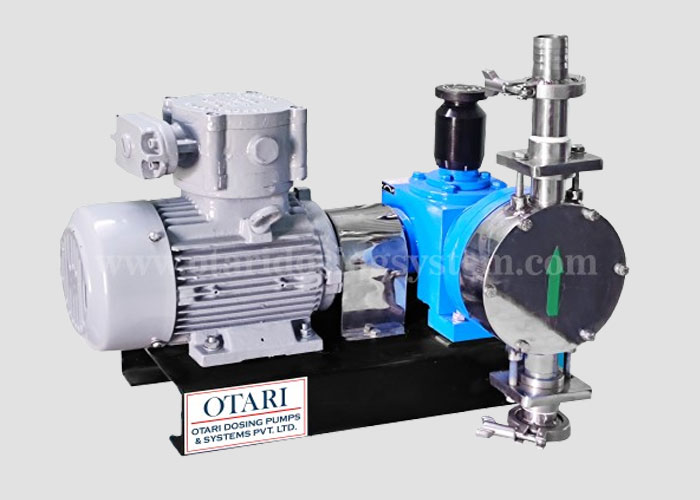
These use a flexible diaphragm driven mechanically, hydraulically, or by a solenoid to push fluid through check valves. They’re widely used because the diaphragm isolates the fluid from the drive mechanism, which helps with chemical compatibility and leak prevention. Diaphragm pumps are a solid default for most chemical dosing applications, including corrosive or hazardous fluids.
Peristaltic Pumps
A rotor compresses a flexible tube to move fluid through it, with no valves or seals in contact with the chemical. This makes peristaltic pumps good for abrasive slurries, viscous fluids, or applications where cross-contamination is a concern, since the only wetted part is the tube itself. The tradeoff is that tubing wears out and needs regular replacement.
Piston/Plunger Pumps
These use a reciprocating piston to generate high pressure, making them suitable for applications that need to dose against significant back pressure. They tend to offer very good accuracy but can be more expensive and less tolerant of abrasive fluids than diaphragm designs.
Solenoid-Driven Pumps
A solenoid drives the diaphragm directly, which keeps the design simple and relatively affordable. These are common in lower-flow, lower-pressure applications like small-scale water treatment.
Matching the pump type to the fluid and pressure conditions above usually narrows the field quickly.
Step 5: Consider Accuracy and Control Requirements
Not every application needs laboratory-grade precision, but some absolutely do. Water treatment plants dosing disinfectants often have regulatory accuracy requirements. Pharmaceutical and food processes may have similarly strict tolerances.
Look at:
- Repeatability. How consistent is the pump’s output over time and across its flow range?
- Turndown ratio, again, since accuracy tends to degrade at the low end of a pump’s range.
- Control options. Manual, analog (4-20mA), and digital/networked control all have their place. A process with variable demand often benefits from a pump that can adjust its output automatically based on a flow signal, pH sensor, or chlorine analyzer, rather than requiring manual adjustment.
If your process ties dosing to a variable like flow rate or a measured chemical concentration, a pump with built-in feedback control or PLC integration will usually outperform a fixed-rate pump on both accuracy and chemical cost.
Step 6: Factor in the Installation Environment
Where the pump will actually sit matters more than people expect.
- Temperature. Extreme heat or cold can affect diaphragm flexibility, seal integrity, and fluid viscosity.
- Hazardous locations. If the pump will operate near flammable vapors or in a classified hazardous area, it needs to meet the relevant explosion-proof or intrinsically safe ratings.
- Outdoor exposure. UV resistance and enclosure ratings (IP65, IP66, etc.) matter for pumps installed outside or in wash-down environments.
- Space constraints. Skid-mounted systems, tight equipment rooms, and remote installations all have different footprint and maintenance-access needs.
A pump that performs perfectly in a climate-controlled lab test may behave very differently after six months outdoors in direct sun or in a freezing pump house.
Step 7: Plan for Maintenance and Total Cost of Ownership
The sticker price on a dosing pump is only part of the cost. Diaphragms, seals, check valves, and tubing all wear out, and how easily they can be replaced affects both downtime and long-term expense.
Ask:
- How often do wear parts need replacement with this fluid and flow rate?
- Are replacement parts readily available, or will you be waiting on a special order?
- Can the pump be serviced without pulling it from the line entirely?
- Does the manufacturer offer local support or technical documentation you can actually use?
A cheaper pump that needs a rebuild every three months will cost more over two years than a pricier pump that runs reliably for five. It’s worth running that comparison before committing to a purchase.
Common Mistakes When Selecting a Dosing Pump
A few patterns show up repeatedly in the field:
- Sizing for average flow instead of peak demand, which leaves the system unable to keep up when conditions change.
- Ignoring chemical compatibility charts and assuming “it’s just plastic” will hold up against a specific acid or oxidizer.
- Choosing based on price alone, without factoring in maintenance frequency or downtime cost.
- Skipping the pressure calculation and later discovering the pump can’t push fluid against actual system back pressure.
- Overlooking control needs, installing a fixed-rate pump into a process where demand actually varies throughout the day.
Most of these come down to skipping one of the steps above rather than any single bad decision.
Final Thoughts
Choosing the right dosing pump isn’t about finding the most advanced or most expensive option on the market. It’s about matching the pump’s materials, flow range, pressure rating, and control capability to the specific demands of your process. Take the time to map out your chemical, your flow requirements across the full operating range, your system pressure, and your environment before you compare pump models.
A dosing pump that fits the job will run quietly in the background for years. One that doesn’t will show up on your maintenance log every other month, and eventually in a process upset that costs a lot more to fix than the pump itself would have cost to size correctly the first time.
Frequently Asked Questions
What’s the difference between a dosing pump and a metering pump? The terms are generally used interchangeably in industrial settings. Both describe pumps designed to deliver precise, controlled volumes of fluid rather than simply moving liquid in bulk.
How do I know what size dosing pump I need? Start with your process’s minimum and maximum flow demand, then check that against the pump’s rated flow range and turndown ratio at your required discharge pressure.
Can I use the same dosing pump for different chemicals? Sometimes, but only if the wetted materials are compatible with all the chemicals involved and the pump is thoroughly flushed between uses. When in doubt, dedicate separate pumps to separate chemicals.
How often should a dosing pump’s diaphragm or tubing be replaced? It depends heavily on the fluid, flow rate, and duty cycle. Abrasive or corrosive fluids shorten component life significantly compared to clean, compatible fluids. Check manufacturer guidance and monitor performance rather than relying on a fixed schedule alone.
